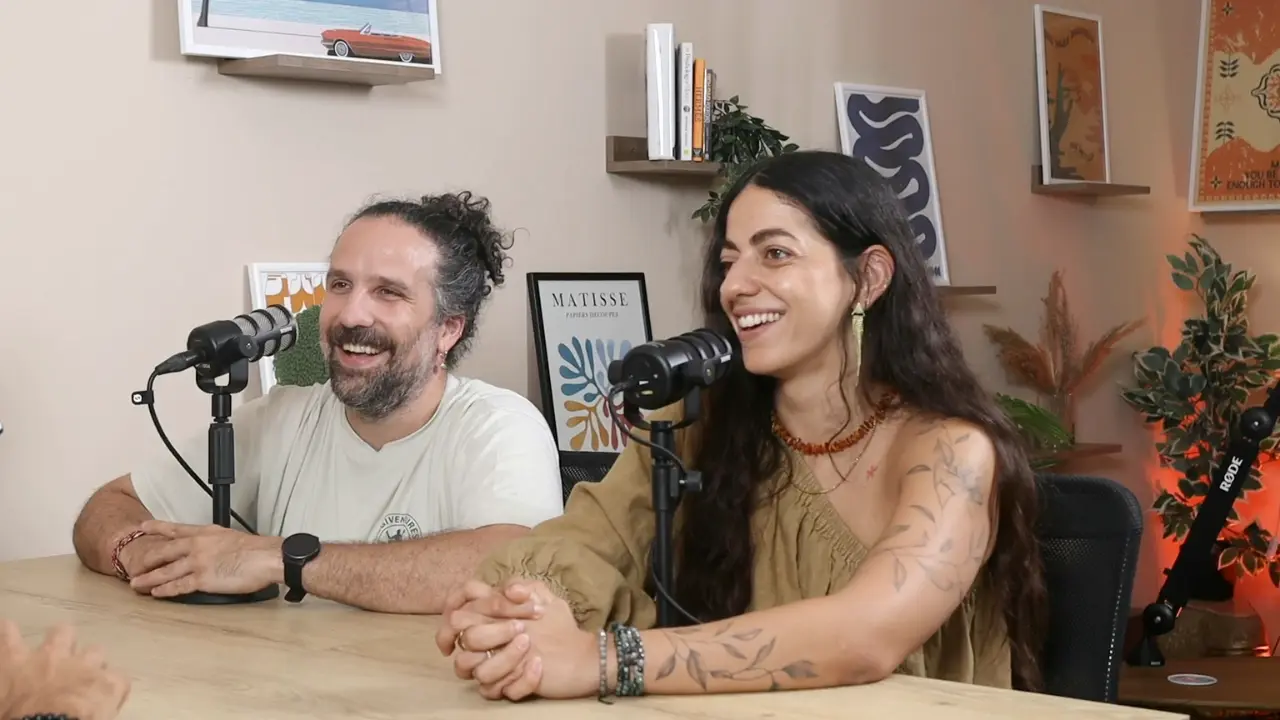
Most weight-loss advice starts and ends with the physical: eat less, move more, pick a diet. But if that were the whole story, far fewer people would spend years losing the same 10 kilos and gaining them back. In this episode of The Weigh In, Steve Hoyek sits down with weight-loss coach Joelle Deaibess to talk about the part that usually gets skipped — the mental and emotional side of eating, and why willpower alone rarely holds.
Joelle Deaibess — known online as Coach Joelle (@coach.joelle) — is a weight-loss coach, personal trainer, and emotional-eating specialist. She started out as an architect before moving into nutrition, personal training, life coaching, and NLP. Her approach is shaped by her own history: she describes being 20 kg heavier five years ago and cycling through restrictive diets for most of her life before understanding the role emotions played in her eating. Through her BetterMe program, she now coaches clients — mostly women — across nutrition, training, and mindset.
What emotional eating actually is. Joelle describes emotional eating as eating driven by a feeling rather than by physical need — stress at work, boredom at home, tiredness, anxiety, sadness, even happiness. Her point isn't that this makes someone broken; it's that food often stands in for something else, and naming that is the first step.
Why she treats weight loss as 50/50. For clients who've carried excess weight for years, Joelle argues the physical plan (what you eat, how you train, how you recover) sits on top of the mental and emotional. Someone can eat less and move more and still regain everything, because the limiting beliefs underneath never changed. Many long-term emotional eaters, she says, have been coping this way since childhood and carry the pattern into adulthood — where, as adults, they finally have the agency to change it.
Telling physical hunger from emotional hunger. This was one of the most practical moments of the episode. Physical hunger, Joelle explains, shows up from the neck down — an empty stomach, low energy, sometimes shakiness — and it's gradual and general (you'd eat almost anything). Emotional hunger shows up from the neck up — thoughts and feelings — and it's sudden and specific (you want that one particular food, and nothing else satisfies it). Her simple prompt: where do I feel this — in my body, or in my head?
Where a coach ends and a therapist begins. Joelle is clear that coaching and therapy aren't the same work, and often run in parallel. She works on limiting beliefs and goal-focused change over weeks and months; disordered eating patterns fall in her lane, but clinical eating disorders are a therapist's domain.
Sustainable vs. unsustainable. All diets work, Joelle says, because they create a caloric deficit — but a diet that doesn't fit your life won't last. Instead of asking which diet is "best," she pushes clients to ask what feels sustainable for them, and to be patient: weight that took years to put on doesn't come off in a couple of months.
One change at a time. In the BetterMe program, Joelle works one week and one variable at a time — she often starts clients with something as small as eating slowly, then layers on the next habit once the first sticks. It's the compounding logic she connects to Atomic Habits.
Identity, movement, and recovery. Joelle's mindset frame is to "become her" — to act like the person you want to be until the values and habits align. On training, she flags strength work as especially important for women, pointing to bone health and osteoporosis risk later in life. And her most underrated tip is the least glamorous one: sleep. She aims for eight hours and treats recovery as part of the work, not an afterthought. Supplements, by contrast, she considers overrated for most people until the basics are handled.
Watch the full conversation with Joelle Deaibess on YouTube.
If Joelle's biggest theme stuck with you — that awareness beats willpower — the easiest place to build that awareness is your daily food log. Keep your calories and macros in view with Journable, so consistency comes from clarity instead of guesswork. Download Journable today to get started.
Steve Hoyek: Today I'm joined by Joelle Deaibess, better known online as Coach Joelle. Joelle is a weight-loss coach, personal trainer, and emotional-eating specialist who has helped hundreds of clients across the world transform their bodies, habits, and relationship with food. Her work is also shaped by her own personal weight-loss journey, which gives her a very practical understanding of what people go through — not just physically, but mentally and emotionally. Through her signature BetterMe program, Joelle has built a way to reach thousands of people online and coach them with a more holistic approach: training, nutrition, mindset, emotional eating, and long-term habit change. Today, we're going to talk about sustainable weight loss and what it actually looks like, why so many people struggle with emotional eating, and how to build results that last beyond the first few weeks of motivation. Joelle, welcome to The Weigh In.
Joelle Deaibess: Hello. How are you, Steve? Thank you for having me today.
Steve Hoyek: My pleasure. I'm good. How are you?
Joelle Deaibess: Great.
Steve Hoyek: Joelle, can you tell us a bit about yourself — what you do, your background?
Joelle Deaibess: So first of all, I started in a different world of health and everything else. I actually started as an architect, and then I discovered my passion for fitness. I started as a nutritionist, and then I ended up becoming a personal trainer. Throughout my own journey, I discovered what I want to work with and who I want to work with — and then I discovered emotional eating and everything related to the mental part of fitness, and I decided to be there. Then I became a life coach, and I also ended up becoming an NLP practitioner.
Steve Hoyek: Let's double-click on some of these things. You mentioned you coach clients in weight loss, among other things. Why do you do this? Why do you do what you do?
Joelle Deaibess: As you mentioned, my program is called the BetterMe program. I do what I do because I believe that in every person there's a better version — a version just waiting for them to actually act. So this is exactly what I teach people to do, especially women.
Steve Hoyek: Amazing. And I guess it's also rooted in your own personal journey — that's your motivation, which helps you keep going. Tell us a bit more about that, and what a day in the life of Joelle looks like.
Joelle Deaibess: So, five years ago I was 20 kg heavier. I was always obese — since I was a child. I was born obese, let's say. What happened is I started dieting throughout my life: from one restrictive diet to another, from one dietitian to another, from one coach to another. Along the way, I discovered that I kept putting the weight back on, and something must be off. As I grew older and discovered emotional eating, I understood that my food is not only about food — it's about something bigger, something related to my identity, to how I act with myself, to how I self-sabotage. Once I discovered emotional eating, I understood the actual key — the secrets behind managing your weight, keeping it where it is, and being a better version of yourself. That's it.
Steve Hoyek: I hope we uncover some of these secrets today. Joelle, what is emotional eating — for someone who's unfamiliar with the term, or hearing it for the first time?
Joelle Deaibess: So the term is very self-explanatory — emotional eating — which means I eat based on a certain emotion. Just like stress eating: a lot of people stress-eat at work, stress-eat at home. A lot of boredom eating — you end up eating because you have nothing to do. Tiredness: when people get tired, they just want to sit down, relax, and eat something. It's really based on an emotion. It can be anxiety, sadness — and even happiness can lead you to eat your feelings.
Steve Hoyek: Interesting. I think I fall into some of these categories.
Joelle Deaibess: We all do.
Steve Hoyek: That's a topic for later, maybe. So, Joelle, you're a weight-loss coach. What's the number one obstacle you see with your clients when it comes to losing weight?
Joelle Deaibess: So, weight loss normally starts with the physical part. We start looking at what I can do with my diet, what I can do with my exercise — should I fast? Should I not eat that? We start on the physical side. But in fact, the mental part — especially for those who have had obesity for a very long time — is what matters most. It's the mindset, and everything related to who they are as people. So it's a 50/50 between the physical and the mental part.
Steve Hoyek: In simple terms, what's the physical aspect of weight loss and what's the mental one?
Joelle Deaibess: So I want to explain something related to the bodies. Every human on earth has four bodies. The physical one is one of the four. We have the mental body, the spiritual body, the emotional body, and the physical body — and the physical body follows all the other bodies. Every body can affect the others. When we discuss weight loss on the physical side, we're discussing the result of certain habits, certain beliefs, certain actions. The physical part is what you eat, how much you train, how much you sleep, recovery — everything related to that. And that follows what you actually believe: the mental part, your beliefs, everything that drives you. It also follows the emotional part and how that plays a role in your journey. That's why I always say it's a 50/50 — you've got to work on the other bodies, not only the physical part.
Steve Hoyek: So my own journey, and the knowledge available online, is all about the physical. How can someone start to work on these other bodies if their objective is weight loss? Where does someone start?
Joelle Deaibess: So, the people I work with have been overweight for a very long time. It's not someone who just put on two extra kilos from vacation — it's someone who's been struggling with weight loss for a very long period. That means this person is stuck in a certain loop. So we go and understand why they're stuck in this loop, and what's keeping them from moving forward to the person they're meant to be. When we discuss weight loss, people think black or white — just keep your mouth shut, eat less, move more. But we can eat less and move more and still, at the end of the journey, gain back everything and stop moving altogether. So there's something there — and this is where we start working on the mental part. There are limiting beliefs stopping this person from continuing the journey. People with emotional eating, or even binge eating, have often been doing this since childhood. They're still behaving like a child — from when they weren't able to protect themselves, when they couldn't do anything else. They carried it into adulthood. So this is where the mental aspect plays a huge role: right now you're an adult, and you can actually do something about it. You're not a kid anymore. That makes the whole difference.
Steve Hoyek: So you mentioned a key word there — the difference between sustainable and unsustainable weight loss. What is unsustainable weight loss, and how can one make it sustainable?
Joelle Deaibess: Unsustainable weight loss is something you can't turn into a lifestyle. You see people across the world trying all sorts of diets and committing to one. Someone tries keto and tells you, "I lost 20 kg on keto, but I gained it back." Why? Because keto didn't fit what they want in life. I'm not against any diet — all diets work, because they put you in a caloric deficit, and you end up eating less than you're expending, so you lose weight. That's pure science. But whether it's a lifestyle plays a huge role in whether the person keeps the weight off or puts it back on.
Steve Hoyek: Makes sense. So, for many listeners — how can one tell the difference between real hunger, when the body needs to eat, and emotional hunger? How do I tell the difference, and when should I actually eat versus take a breath or drink some water?
Joelle Deaibess: So, when I learned this, I learned it in a very nice way, and I'm going to share it. Let's start with physical hunger. Physical hunger is everything you feel from here down — you actually feel it in your body. Unfortunately, we've lost this over the years, but we can bring it back. Physical hunger is: how do you feel in your stomach? Is it empty? Do you hear something? Does it hurt? You can also check your energy level — sometimes you feel down, you just want to sit, you're tired. Some people get so hungry they start shaking; you can see it in their bodies. Emotional hunger, on the other hand, is everything from the neck up. So physical hunger is from the neck down, emotional hunger is from the neck up. Emotional hunger is related to thoughts, to feelings, to something that just popped up in your mind. And here's a huge difference that will help a lot of our audience: physical hunger is general. When you're truly hungry, you're willing to eat whatever your mom just made — even something you hate — because you're just hungry. It can be pizza, or anything in our Lebanese culture. Physical hunger is also progressive — it doesn't hit you suddenly. You don't suddenly feel hungry; you feel very hungry because you've left yourself without food for hours. But emotional hunger comes on suddenly, like someone slapped you, telling you to act right away. And emotional eating is usually specific: I want the chips I kept in the cabinet. It comes very specific, and no matter what you eat, you'll go back to that item. That's how you can tell it's emotional hunger. Start by simply asking: where do I feel it in my body? If it's not in my body, it's in my head. Some people have developed it into what we call food noise — it becomes something living rent-free in your mind. So that's something to focus on.
Steve Hoyek: That's so interesting — a lot of this hits close to home. This seems to sit right on the edge of the mental and emotional — domains generally tackled by therapists and psychologists. So where's the line between work that needs a mental health professional and work that's for someone simply aiming to lose weight?
Joelle Deaibess: So there's a degree to everything. First, coaching and therapy go hand in hand. Many of my clients also have therapists, because we do two different things — that's a myth circulating, that we do the same work, which isn't true. Therapists work more on the individual: what's happening with them, how it led them here, everything related to that. What we do — and as a life coach I do this — is work on limiting beliefs and the things stopping this person from moving forward, and then we work toward a goal. You can work with a therapist for years, but you work with a coach for weeks or months — not years — because you're goal-oriented, and that's where you need a coach. In terms of disorders, what I personally work with is disordered patterns — things like emotional eating and binge eating. But when it develops into something major and bigger, like eating disorders such as anorexia or bulimia, that's when we discuss it with a therapist. That's where therapists play a big role, because now it's on another level and you have to work with someone in the mental health field who specializes in it.
Steve Hoyek: Interesting. Let's translate this to practical terms. Say a new client approaches you and they want to lose weight. Where do you start? What do you ask them? What's your process for onboarding a new client?
Joelle Deaibess: So I'll discuss the BetterMe, because that's the service I have. First, I draw a clear path and tell them we have 10 weeks of work. We need this amount of time for them to learn everything they need to and, at the same time, apply it. The first week is all about organization, because emotional eaters usually lack routine — they lack a good nutrition plan, they lack it everywhere. They eat when they feel like it, and no, you can't just eat when you feel like it. So first, I observe the client. About four or five days into the program, I'm just observing how this person acts, what they do daily. Then I start intervening. I see a lot of coaches starting with "okay, let's do one, two, three" — in my case, that doesn't work, because I need to know how this person is conducting their life. Then I intervene, and I start with very small changes, one change at a time, as slowly as possible. That's the only way to keep the bad habits from repeating. We adjust one thing at a time — not ten things at a time. That's a lot.
Steve Hoyek: And how does this tie in with your general philosophy toward weight loss?
Joelle Deaibess: So I say this with ease: weight loss is easy, as long as you figure out what works for you. If you're still trying the Kim Kardashian diet, it doesn't work with your lifestyle. You can't eat like an athlete if you're a mom with four kids — that's unrealistic, and you're asking people to do crazy things. Who can work out every day unless they have access to a gym every day and the time for it? So stop. Weight loss is easy as long as you decide: what do I want to do? What feels sustainable for me? Then I can start seeing results, getting them, and keeping them. That's the only way.
Steve Hoyek: And by the same token, what's one weight-loss belief that many people hold that you'd really wish they'd let go of?
Joelle Deaibess: That weight loss should be limited to a number of months. I work with people who have more than 50 or 60 kg to lose, and I understand how much it hurts to say, "I have 60 kg to lose" — that's a long, long way. So they end up thinking, "I can get this done in four months." No, my love — those 60 kg took you years to put on. Stop expecting weight loss to be done within months. That's something I really wish would disappear.
Steve Hoyek: It's quite a human thing to think in short terms — to think we can hit our goals and then carry on with our lives, when the reality is that the thing that lets us reach our goals is the lifestyle change, which is permanent. Not a one-off, couple-month program after which we're done with the hard work. Joelle, what's the relationship between weight loss and confidence?
Joelle Deaibess: We can't deny how confident we feel when we lose weight — even if it's 5 kg, even if you just kept 1 kg off, that's a huge thing. You feel better in your own body, you feel leaner. But it's never about how much you lost. It's always about what you did to get there — the actions you're taking, the habits you're building. That's what makes you feel confident, because you said you wanted to lose 10 kg, and look at you actually pursuing it and doing the work. Confidence comes from that — because you're living by your values. You're doing what you said you wanted to do; you're not only talking the talk, you're walking the walk. That's what gives you confidence, especially in weight loss.
Steve Hoyek: And how does body image tie into that? They must be closely related.
Joelle Deaibess: A lot. Body image affects how you behave every day. If you're having a bad body image day, you'll hide away in your clothes, reach for comfort food at night, do anything to make yourself feel better. Unfortunately, people act on bad body image days and let them ruin their days. One bad body image day can ruin my week — if I feel I've been hustling for weeks, then have one bad body image day (and for girls it's normally around our period), we'll say nothing has worked, I've been hustling for nothing, so let me go through with it. That's not the case. When we understand and accept our bad body days — accept that sometimes you won't feel your best or look your best — you can just go through it, get over it, and move on. That's when it gets so easy to maintain the result.
Steve Hoyek: That's amazing to hear. Has your own personal journey affected your approach to working with your clients?
Joelle Deaibess: A lot. My personal journey gave me so much patience, and it helped me understand my clients even more. I work with a specific niche — people who have been suffering for years. I have suffered for years — 20, 25 years. I've been dieting since I was seven or eight years old. Because I've been through that, I understand what it feels like when someone tells me, "Joelle, I really can't control it." I understand what it means, because people say, "It's all about willpower, just stop eating when you're full." It's not that easy — I understand what that means. So my approach isn't "you're without power, you're not successful, you're going to fail." No — I understand the client, I can relate, and a simple act of validation gives them a huge push. Telling them, "I've been there, and it's okay to feel that; just move on, it's going to get better" — from personal experience, not only from the knowledge I have.
Steve Hoyek: Personal experience, and the experience of working with hundreds or maybe thousands of clients through your program. You must derive so much fulfillment from helping your clients reach their objectives.
Joelle Deaibess: A lot. I've helped more than a thousand people — over 1,500, to be exact. I love what I do, I do it with passion, and yes, I thrive in my work.
Steve Hoyek: That's amazing. Joelle, you talk about a holistic approach to health and weight loss. Can you tell me more about what that means?
Joelle Deaibess: So, as I mentioned, weight loss is about the other bodies, not only the physical one — the mental one, the emotional one. What I want you to understand is that when you change your identity, when you change who you are, you can actually maintain the results you want. Because my program is the BetterMe and I work mainly with women, we always search for her — her, capital H. We start visualizing her. My client will say, "I want to wake up every day energized, have a well-balanced breakfast, then hit the gym for an hour and come back home." They give me the exact life of this person. But then we come to their real life, and they tell me, "I don't feel like waking up at 5 a.m. I don't feel like going to the gym every day." But my dear — for you to reach her, you've got to start acting like her, start being her. When you change your identity, only then can you maintain the life you're dreaming of. You've got to become the person who loves to eat healthy because it makes them feel good — because eating healthy means you're balanced, you're light, you move with ease, your energy is always available. Someone who doesn't nourish themselves, who eats because they have to, who eats to punish themselves, isn't aligned with what they really want. When you tell me you want to move a lot, and you end up moving ten minutes a day and saying, "I can't do it anymore," but you really want an hour of movement — then you've got to start acting. You've got to start loving yourself through movement. That's what "love yourself" means. My philosophy is: love yourself enough to want to change and become the person you really want to be. It doesn't suddenly appear. People expect that once they lose the weight, they'll become that person. No, my love — it doesn't happen that way. You've got to start acting like her, being her, treating yourself as if you were her. Some people don't treat themselves well — they say, "I have to lose 20 kg so I can get a reward." No — every milestone matters. Stop telling yourself, "I don't reward myself at every 1 kg." No, treat yourself with love, treat yourself with ease. On the mental side, you become the person who is kind, compassionate, who loves herself. And her nutrition values now align with her identity values; her exercise values align with her identity values, and how she moves through a situation. That's what makes the whole difference.
Steve Hoyek: It makes complete sense. It's so interesting that there's such a dichotomy between people's vision of the perfect them and their day-to-day — despite the only difference in practice being waking up earlier and doing the work. There's no physical restriction stopping them. They can choose to eat healthy or buy the healthy groceries. I've faced this personally too — some days I know what my ideal morning looks like, and some days I wake up with no energy to do any of it, despite the fact that it's all intrinsic. I could muster the energy, get up, and become the person I've envisioned.
Joelle Deaibess: It's the fact that these days will happen. No human on this earth doesn't go through bad days. But you can't have a majority of bad days and some good days — you've got to have a majority of good days and then some bad days, where you're okay saying, "I really need the rest today, I'm staying in bed." Take it, for sure. But if you're acting like the person who thinks life is against him and nothing goes his way, you'll become that person with a very negative mindset, and move through life with it.
Steve Hoyek: Makes complete sense. So for one of your clients, you touch on many aspects — physical, mental, emotional, mindset. How do you communicate all of this, or get them to do the work, without overwhelming them? Change isn't easy. You can't eat an elephant all at once — you do it one bite at a time. I'd love to know your approach.
Joelle Deaibess: Exactly. In the BetterMe, we go one week at a time. We start counting the weeks, counting the days — we have diaries, simply to see what we've been doing. We implement change one thing at a time. For example, the very first thing I do with a client, related to eating behavior, is getting them to eat slowly. It's that easy — I start with the small stuff. Once they've mastered eating slowly, I add something else. We work on everything, but one variable at a time, and they build up. So one week you learn to eat slowly; the second week you understand your physical hunger. The first week carries into the second, and now you're eating slowly and understanding your hunger. Third week: one, two, three. Fourth week: one, two, three, four. They add up without the huge pressure of doing everything at once. In Egyptian we say something that means "one grain at a time" — one grain, one grain, and they add up. They absolutely do.
Steve Hoyek: They absolutely do. The impact of small changes, small habits, little daily things, little changes in routine — they compound. And the whole is greater than the sum of its parts. It eventually lets someone reach their goals far more effectively than they thought. It's amazing how small changes in habits can have this huge impact on someone's life.
Joelle Deaibess: You reminded me of a book I'd tell you to read — Atomic Habits. It's a great book that tells you small effort builds into a habit you can sustain into getting what you want.
Steve Hoyek: That's amazing. Joelle, what about strength training? Do you incorporate it into your program, or is it something you do personally with clients?
Joelle Deaibess: So, going back to the idea of me being the best version of me — does the best version of you train? Definitely. Who doesn't like to move their body in their own way? You can do strength training, yoga, dance — whatever you want. In the end, you've got to tell me you imagine your better self moving. Because moving feels good regardless of how it makes you look — it just makes you feel amazing. The endorphin rush, the breath you take after a training session — it feels great. So strength training is essential. And because we're discussing women and the female body, osteoporosis is one of the major diseases that happen after 40 and 50, especially for females. Strength training is one of the best ways to get stronger bones, so you can end up at 60, 70, 80 not falling on the ground because you have weak bones. No — that's not her. Her is looking like Jennifer Lopez right now. That's how she looks.
Steve Hoyek: It's amazing. You cover so much with your clients, and you do a lot of it online. Can you tell me more about how you found what works and translated it to working with people online — despite the difference between an in-person accountability check and something online? How did you scale it to thousands of people?
Joelle Deaibess: You create a system. First, you start small and then build up. I wanted to travel while working — I wanted to be as free as possible. I didn't want to be the typical "go to a clinic" type of coach. So I started building the system. First, I hired many mentors — I invested a lot in myself and my business. Investing is the way. I started getting people to be more accountable with me: even if I'm not physically there for you, I am here for you. So I send them reminders all the time; we have regular check-ins. I personally do weekly check-ins, which is the highest level of accountability you can get. I have my own community — the Fashfasha community — where all my people in the BetterMe are, and we have group sessions every single week. If you're with me in the BetterMe, you have the one-on-ones where we personally work on your journey, and then the group and the community — because community is the most amazing thing. You feel like you belong, and you can discuss your problems with a total stranger. It feels ten times easier to say, "Look, I'm afraid of my dad," to a total stranger than to someone you know.
Steve Hoyek: Or your dad.
Joelle Deaibess: Exactly — or your dad. So it's ten times easier.
Steve Hoyek: Interesting. How much of your online services are standardized versus personalized to each client?
Joelle Deaibess: The only part that's standardized is the education, because we work on three aspects: the nutritional, the training, and the mental. In terms of education, that's the one thing that can stay with them, so the education is standardized for everyone. I teach them all what TDEE means, why training is so important, why protein is so important. Now they understand and can work from a point where they have the education behind them. Everything else is fully customized, because every girl is going through her own things. For one girl it's because of her mom; for another it's diet culture, or someone she saw on socials. It's a very different journey, and each girl needs help in a very specific aspect. That's what we tackle.
Steve Hoyek: Amazing. What about clients who come to you and say they've tried everything — every diet, every lifestyle change — and nothing has worked?
Joelle Deaibess: I tell them to try again. Because guess what — I tried again, I don't know, a thousand times. And you haven't tried everything, because you haven't found what works for you. The best is out there. So stop telling yourself you've tried everything. Did you actually work with someone qualified? Not just spend 20 bucks on a challenge and say you tried everything. Did you work with someone who understands you, who listens to you, who takes your lifestyle into account? That's very important. So no — try again. One word, two words: try again.
Steve Hoyek: What about the other end of the spectrum — someone who decided for the first time they want to lose weight, but they're new to this space? They don't have the knowledge or the information. What's the playbook you'd give someone who has just decided to start losing weight? What are the simple steps?
Joelle Deaibess: So, again — tell me your history, tell me everything you've been through, how many diets you've tried before, because they probably have tried things that didn't work. I'd tell them: start by actually saying what can I do — not create an unrealistic expectation of getting up at 5 a.m. That's not reasonable when you've been waking up at 11 a.m. So let's see where I can actually make a difference. If I want to wake up at 5 but right now I wake up at 11, I'd start with 10, then go to 9, and so on. So: what can I do? What are the small things I want to do? And I focus on three elements. Focus on your nutrition — if you want to lose weight, you've got to be in a caloric deficit. Find the diet that fits you, not the other way around. Don't say, "I'm going to try keto" — based on what? Start with something that resembles you. Maybe start with flexible dieting — the 80/20 rule, where you can fit some of your life into it. So: caloric deficit, get enough protein. Protein isn't only for muscle — your hair is made of protein, your nails are made of protein. Start understanding why we get protein. In terms of training, understand what actually works for you — what you enjoy. Many of my clients do dance classes, yoga, Pilates, strength training, biking, cycling, Muay Thai, whatever. They choose the activity they can endure for a long time and actually enjoy. I have a client who only dances — oriental dancing — and I'm so happy for her. If that keeps her moving, I'm happy for her. And then work on your mindset. The person who wakes up at 5 a.m. enjoys it, loves it, adores it — she hates waking up at 7. So you've got to start being that person. Going back to identity and values, you've got to be that person, enjoy it, love it. That's when you get to see people who made a change and stuck to it — or those who now love doing it. I had a friend who used to hate the gym. We started going together, and she'd tell me, "Joelle, I'm never going to sustain this, I don't like the gym." I said, "Wait — I'm going to give you a program, we'll work on it, and we'll do it your way." She left me two years ago and she's still training like a beast, because now she enjoys it. That's the only way you can continue doing something — they start enjoying it. You notice how they think now. She'll tell you, "I'm going to ask for the chicken salad, because I actually want to maintain my results. I like the chicken salad."
Steve Hoyek: I love chicken salad.
Joelle Deaibess: Chicken salad — exactly. So it's as easy as that. They become the people who love doing this. It's not a punishment; they love doing it.
Steve Hoyek: Love it. So the playbook, I guess, is: calorie deficit, track your calories, a good balance of macros, get your protein in, find some form of movement you enjoy and love — and embody your identity.
Joelle Deaibess: Exactly.
Steve Hoyek: Embody the identity of the person you'd like to be. Love it. What's the uncomfortable truth about weight loss that most people don't want to hear?
Joelle Deaibess: I think it's that it takes time. That it takes time is huge, and you've got to be patient. You've got to be patient and try new things. If you keep doing the old things, you'll end up with the same results. You see people going back to the same dietitian or coach, telling you, "I benefited a lot with this person, I lost 10 kg" — but guess what, you gained them back. It means it didn't work your way. So find something new and try it. You might end up enjoying it — but be patient. Patience is underrated. You've got to be patient, especially for those who have a lot of weight to lose.
Steve Hoyek: It's unrealistic to set expectations like "I'm going to lose all this weight in two months."
Joelle Deaibess: No way. And if you did, you'd be living in hell — because you didn't get here in a sustainable way. You hated how you got here.
Steve Hoyek: Patience, sustainable weight loss. Love it. Joelle, let's move on. There's a section of the episode called The Protocol — it's more about your approach, your perspective, and how you live your life. First question: what's your morning routine — your first 60 to 90 minutes, no filter?
Joelle Deaibess: So I wake up around 6 or 7 a.m., depending on my energy levels. I used to wake up at 5 — it didn't suit me anymore, so I moved to 6. First thing I do is drink two glasses of water. I've been doing this for 10, 15 years — non-negotiable. Two glasses of water. Then I sit down and set the mood — sometimes I light a candle; I love scented candles. I bring my journaling book — and here's a shout-out to Coach Leia, because I got her notebook. I start by writing my affirmations: who I am. Your affirmations draw your path in life. "I am happy. I am satisfied" — whatever you want to say. Then, what am I grateful for? Three things I'm grateful for, because I remind myself there's a lot I want, but at the same time I'm grateful for a lot. Then we set the intention of the day — it's literally in the notebook, it's an amazing notebook. Intention of the day, then I move to writing down what I have to do, and journaling: how has it been, how am I feeling, what do I want? Currently I'm not doing it, to be honest, but sometimes I do some ice water for my face — I dip my face in ice water. Cold exposure trains the mind.
Steve Hoyek: Trains the mind.
Joelle Deaibess: Yeah. I don't do it for other benefits — I do it for the resilience. So I do that, and then for about half an hour I start setting up my day. You can start with slight movement — I'm personally not doing the slight movement right away, but slight movement, stretches, yoga, anything you'd love. Then you move on to work or studying. I study — I'm very creative in the morning, so I study or write content in the morning. My highest level of productivity is in the first four hours of the day; I benefit a lot from them.
Steve Hoyek: Your morning routine seems like a combination of The Miracle Morning by Hal Elrod and an Andrew Huberman morning. It's a nice combination. I think you found what works for you.
Joelle Deaibess: Exactly. I do things my way. Always.
Steve Hoyek: That's awesome. Next question: what's the most overrated thing in health and fitness right now?
Joelle Deaibess: I'd say supplements — because everybody's pushing supplements on us. Supplements are the top tier of a pyramid. We don't go to supplements unless we need supplementation. It's literally in the word — supplements. So how can you tell me you're having 12 types of I-don't-know-what, and you don't even have a good breakfast, you barely train, but here you are drinking your "superpower"? You can see this a lot — people consuming electrolytes. If you're not an athlete who's sweating and working for four hours straight, electrolytes don't benefit you at all. People are supplementing like crazy, and supplements are being pushed in a crazy way. Three supplements that work: I'd personally say caffeine — caffeine is an awesome supplement, just don't overdo it.
Steve Hoyek: We love caffeine.
Joelle Deaibess: I love caffeine. Two, I'd say creatine — creatine is now being researched for cognitive benefits, not only everything related to muscle. It's one of the most researched supplements there is. And thirdly, whey protein, in case you need it. Joelle, it's ultra-processed — but girl, you're barely getting your protein intake, so you might as well have one scoop and get your protein in. "My hair is falling." Guess what — that's it. So in terms of supplements: supplements are overrated.
Steve Hoyek: And on the flip side, what are some underrated health and fitness tips?
Joelle Deaibess: I'd say people don't focus on sleep and recovery as much, because everybody wants to do the conscious work. They want to rock the world and then end up sleeping two or three hours. You can't do that. You want to lose weight and manage it? You've got to sleep well. You want the greatest physique, you want to grow your muscles? Sleep well. Recovery is very underrated in our industry, because people don't want the easy stuff — the things they're actually able to do. I literally sleep 8 hours every day. Non-negotiable. I go to sleep at 10 p.m. In case I really need to work an extra hour, I go for 11 p.m. — head straight to bed, wake up at 7. It's important to get those eight hours. Please focus on recovery. It matters way more than your supplements. That's where the magic happens — sleeping.
Steve Hoyek: That's where the magic happens. Just sleep.
Joelle Deaibess: Just sleep. It's free.
Steve Hoyek: So there's a lot going around social media — a lot of it is rage bait and noise. What's the worst advice you hear circulating online these days?
Joelle Deaibess: "Sit on it. Take all the time you need. You're unhappy." Okay — so let me suffer in my misery a bit more? "I'm going to get back to you, coach — right now I'm overwhelmed with life." Why? When does life get easier? When does it ever get underwhelming? I want a life that's underwhelming. It's never like that. So stop sitting on it. You're unhappy in your body, unhappy in your mind, unhappy in your relationship — stop telling yourself it's about time, that time will pass and I'll be better, and then I'll be ready to start. You're never going to feel better if you don't start. Never. So please, don't sit on it.
Steve Hoyek: By the opposite token, what's the best advice spreading online at the moment?
Joelle Deaibess: The best advice is to treat your body with respect, love, and compassion. I see a rise in the body-positive movement — and I have my own opinion about that — but what I love is people starting to get that my body is my home. If you live in a house, you never leave it dirty, smelly, un-clean — you might for a day or two, and that's fine, but you don't live with chaos. Nobody lives with chaos. So treat your body with respect, with love, with the care you'd give if — if I gave you your mom's body today and told you to take good care of it, you wouldn't feed it the way you feed yourself, you wouldn't treat it the way you treat yourself. You'd take her and train her even if she doesn't feel like it, because you want your mom to be healthy at 60 or 80 — you want her to be able to get herself to the bathroom. That's how you treat her body. I think that's so beautiful. Treat yourself with compassion. Not every day is going to be amazing, not every day are you going to feel like you want to rock the world — and that's fine.
Steve Hoyek: A very valuable piece of advice everyone should adhere to is to treat yourself with the same respect you treat your friends and family — because a lot of the time we treat others far better than we treat ourselves. That's definitely a key takeaway. This was awesome. Just before we close, I'd like to ask you to share one thing you'd like to leave the audience with today.
Joelle Deaibess: My motto in life is: try again. Try again, try again. There's no such thing as "this is how it is." It's not how it is — you made it. You can take yourself out of it. Please, try again. As much as it takes. Even if you've tried a thousand times, the ten-thousandth might be the one that gets you out of your phase. It might be it.
Steve Hoyek: Love it.
Joelle Deaibess: So try again. Give yourself as many chances as you gave that ex. You deserve it, right? So do that. I'd say: try again.
Steve Hoyek: This has been amazing. Just before we close — any call-outs or shout-outs you'd like to make?
Joelle Deaibess: Yeah, I want to thank Coach Shana, Coach Shihan, Coach Leia, and Coach Dalio. They've been the pillars of where I am today.
Steve Hoyek: Amazing. And if someone from the audience would like to connect with you or reach you, how can they do that?
Joelle Deaibess: You can follow me on Instagram — it's @coach.joelle — or you can simply WhatsApp me. [Contact number shared on the episode.]
Steve Hoyek: Amazing, Joelle — it was a pleasure. Thanks for coming on.
Steve Hoyek: Thank you for watching The Weigh In podcast by Journable. We'd really appreciate it if you follow us on Instagram at Journable HQ and give the app a try — it's an AI calorie tracker. Download the app, let us know your thoughts, and send us any feedback. We'd love to have you there. Thank you.