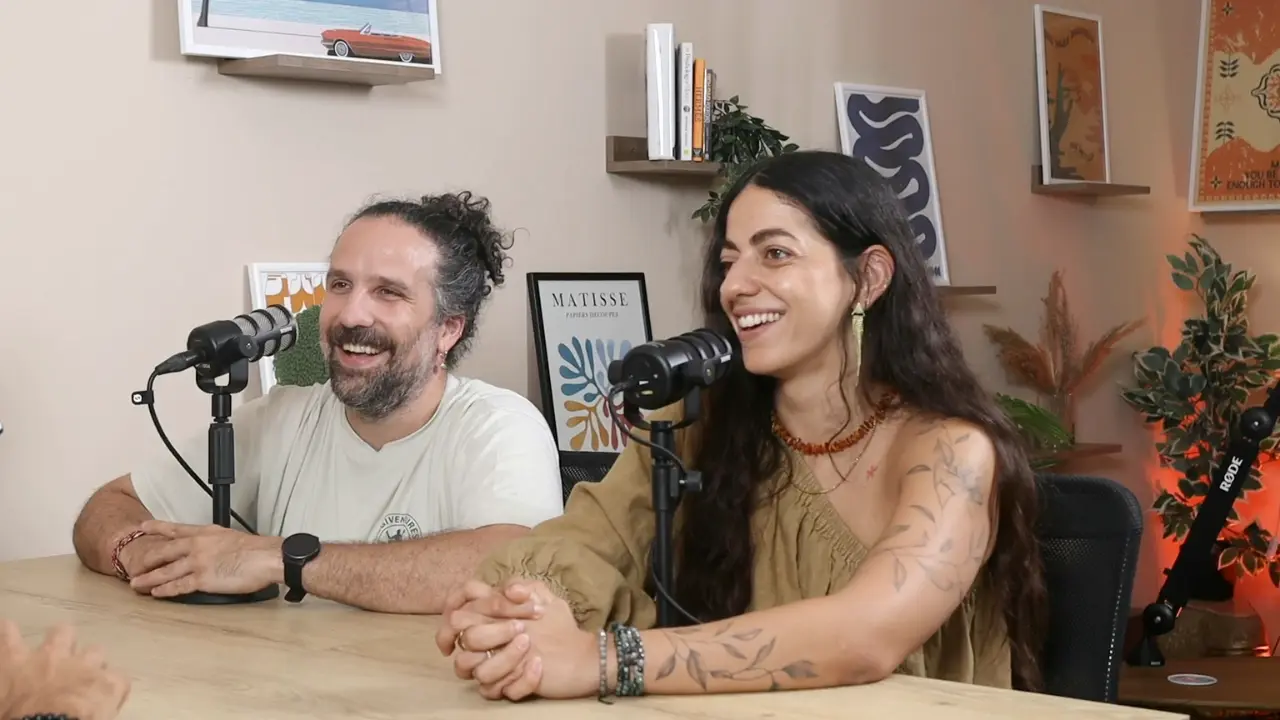
Fitness advice often zooms in on the workout: the exercise, the number of sets, the weight on the bar. Coach Georges Fayad takes a wider view. The hour spent training matters, but so do the other 23 hours—how you move, sleep, recover, eat, handle stress, and live.
In this episode of The Weigh In, Steve Hoyek speaks with Georges about moving from corporate marketing into coaching, starting calisthenics from zero, adapting training to the person, and why a useful fitness routine should help you feel and move better—not only look different.
Georges Fayad, also known as Coach G, is an NCSF-certified personal trainer, class coach, and co-founder of Move Lebanon. He coaches calisthenics, strength and conditioning, and general fitness, and he teaches people whose goals range from learning their first bodyweight skills to improving strength, health, or daily function.
Before coaching full-time, Georges spent close to a decade in marketing and advertising. He says the change was less about leaving work he could do well and more about moving toward work that gave him a stronger sense of passion and purpose: teaching movement.
One of Georges's clearest ideas is that training occupies only a small part of the day. A program can improve performance during that hour, but its value also shows up outside it: playing with your children, carrying things, walking, climbing stairs, moving without feeling stiff, and having enough energy for daily life.
That is why his definition of fitness is broader than a single goal or discipline. A person may care about strength, muscle, skills, aesthetics, longevity, or simply feeling better. The program should reflect that goal, but it should also fit the person's life rather than compete with it.
When a new client arrives, Georges does not begin by choosing exercises. He first wants context. Has the person trained before? Are there injuries that need professional clearance? How are they sleeping and eating? How much stress are they carrying? What do they enjoy, and what made them decide to start now?
That last question matters because many adults have had years in which they could have joined a gym but did not. Understanding what changed helps a coach make the first sessions feel relevant rather than intimidating.
Georges's approach is deliberately patient. For someone who is nervous or inexperienced, an aggressive first workout can reinforce the idea that exercise is punishment. A better early target is a session the person can complete, understand, and feel good about—then repeat.
Georges uses his own calisthenics journey as evidence that the starting point does not define the outcome. When he began, he used knee push-ups, could manage one dip, and performed partial pull-ups. Years of practice later, he had reached personal records he was proud of and was comfortable maintaining rather than endlessly chasing more.
The lesson is not that everyone needs to pursue calisthenics. It is that progress can begin below the version of “beginner” shown online. Small wins create momentum, and momentum makes showing up easier.
The same principle appears in how he describes a client's weekly routine: two bodybuilding sessions and one calisthenics session, organized around the client's interests. The routine works partly because the client enjoys the skill work and wants to return.
Georges separates training methods by their main purpose. Strength work generally emphasizes heavier resistance, fewer repetitions, and longer rest. Hypertrophy training uses more volume to prioritize muscle growth and aesthetics. General fitness and conditioning use a wider mix of squatting, hinging, pushing, pulling, carrying, rotation, and cardiovascular work.
These are not sealed categories. Georges's own training blends resistance work, calisthenics, bodybuilding accessories, and padel. The mix changes with his schedule and what he needs his body to do.
For readers interested in the long-term case for resistance exercise, Journable's earlier guide explains why strength training matters for women. Georges's point in this episode is broader: choose methods based on the outcome you need, then combine them when your goals call for more than one quality.
Georges repeatedly brings the conversation back to the time outside the gym. He encourages beginners to walk, sleep, manage stress, eat mostly whole foods, and avoid turning every session into a test of maximum effort.
He also describes personally seeing better results during a period when he trained three times a week rather than five because he felt he recovered better. That is his experience, not a universal prescription, but it illustrates the larger point: more training is not automatically better if the schedule is difficult to recover from or impossible to sustain.
Nutrition fits the same practical frame. Georges prefers whole foods first and treats protein bars or supplements as optional additions rather than the foundation. The useful question is not whether a product is “good” or “bad” in isolation, but whether it helps a person meet a real need within an otherwise workable routine.
Georges and his partner Yara created Move Lebanon to bring different forms of movement, sport, and wellness into shared events. Rather than building every gathering around one discipline, they have experimented with combinations such as kayaking and stretching, calisthenics, dance, and water-based classes.
The goal is not only exercise. It is to help people discover ways of moving they enjoy while building connection around the experience. That community element supports the same philosophy Georges uses in coaching: movement is more likely to last when it feels welcoming, meaningful, and enjoyable.
You can watch the full episode on YouTube, listen to the episode on Spotify, or anywhere else you get your podcasts.
Georges's closing advice is simple: do not take the process too seriously, find movement you love, and train to feel good. That does not mean goals or structure do not matter. It means they should support a life you want to live rather than becoming another source of noise.
If seeing your meals more clearly would help you support training and recovery, download Journable to track calories, protein, and macros.
Steve Hoyek:
My guest today is Georges Fayad, aka Coach G. Georges is a personal trainer, class coach, and co-founder of Move Lebanon, a community built around movement in all its forms. Not just one sport, one method, or one type of training, but a broader approach to helping people move better, get stronger, and build a healthier lifestyle. He works with people with very different goals. Some want to get in shape, some want to build strength, and some want to learn calisthenics, some want to look better, and some just need guidance to improve their health and longevity.
Today, I want to unpack how he thinks about training different people, what actually matters in a good program, and why fitness is not just about what you do for one hour in the gym. Georges, welcome to The Weigh In.
Georges Fayad:
Hi, Steve. Awesome to be here. I'm so glad to be here, really. So, hi, everybody. I'm Georges, aka Coach G, co-founder of Move Lebanon, and really, it's such a pleasure to be here. So, I'm 34 years old and I've been in corporate for the past eight to ten years and really switching to sports is just a passion of mine. I've been into sports since I was a kid and now it's part of my daily life. I'm just so grateful for it.
Steve Hoyek:
So, Georges, thanks for coming on. Tell us a bit about you, what you do, how you spend your time, your background.
Georges Fayad:
Of course. So, I'm a certified personal trainer from NCSF. I've been a certified personal trainer since Jan 1st, 2023, actually. And I teach calisthenics, I teach strength and conditioning, I teach general fitness, snowboarding. So I have so many different passions for sports, so many different passions for teaching sports because I do believe there is a difference between doing a sport and teaching a sport. They're two different things and just teaching it is a big big big passion of mine and I'm so glad it's part of my daily life and daily habits.
Steve Hoyek:
So tell me about this transition from corporate into training and movement. What are movement and training to you, exactly?
Georges Fayad:
For me, movement and training are part of my daily life. So, for example, I can train on something specific, but the end goal could be something else. I train one hour per day, but the rest of my day is defined of how my training goes. It's just there is the remaining 23 hours per day. If at the end goal, I'm just gonna be older and I'm gonna be, I need movement in my life just to have longevity and just to keep moving, you know, it's part of my daily life. I need to be fit for myself.
I need to be fit for my kids. We're gonna move, we're gonna jump, we're gonna play. So, it really is something that I should implement on a daily basis just to stay healthy and fit.
Steve Hoyek:
Love it. And you mentioned you got certified on the first of January. So, did you do this over New Year's? Like, did you finish your certification on New Year's Eve?
Georges Fayad:
I actually studied for like 11 months, it dragged a bit because I was so busy with, I still was in corporate, in the corporate world. So my studies just dragged a bit, but I'm so glad I aced the test, which is the most important thing. And now I'm able to teach professionally what I preach. So I'm just glad for this. That's awesome. What's your corporate background just out of curiosity? So I'm marketing and advertising, which is well, actually, I'm really good at it as well. And I was good at my job.
It's just, it wasn't passion, it wasn't pure joy, and it wasn't teaching. And movement and teaching is passion. That's awesome. Yeah, exactly. So
Steve Hoyek:
tell me, tell me, let's say a client comes up to you, you're a personal trainer, right? This is how you spend a lot of your time. Client comes up to you. What's the first set of questions you ask them? How do you learn what they want and how do you program for them? Of course,
Georges Fayad:
we have to keep in mind that all clients are really different. I don't know them, they don't know me. But what I do know is the set of questions I'm gonna ask that client. So I need to know first of all their background in sports. Have they ever moved in their life? What do they do? Do they have injuries? If they have injuries, have they been cleared by their physio? How do they eat? How do they sleep? Is there stress in their life? There's so many factors that I have to take into consideration before assessing them.
Even if they're first-timers in the gym, I cannot push resistance training at first glance because if I do, they will be scared and they will not come back. My approach to a client is: I have to be patient with them, I have to incorporate fun conversation just to make them feel comfortable. Remember, if they're adults, they've had their whole lives to come to the gym, but they didn't, they chose now. Why did they choose now? So, what's this thing that their mind told them that now is the time to go to the gym.
So I have to understand this in order to assess my workout plan for this client and the program for this client.
Steve Hoyek:
Interesting. So there's a huge aspect which derives from different motivations, right? Some people who are intrinsically motivated, others extrinsically. Can you talk to me a bit about that?
Georges Fayad:
Motivation is such a weird factor, such an important factor. I mean, for example, as a coach, the motivation they say that the coaches come and they're like, oh, happy for me, as an example, I'm always smiling at the gym because one, I teach a sport, I do it with passion. But at the same time, behind closed doors, I'm teaching this one-hour with the client, but I still have as well the 23 remaining hours of my day. But they say there is something like face on, face off, face on that you do with the client.
So at the same time, when the client comes in front of me, I should be smiling, I should be receptive, I should engage in conversation, I should engage like, how's it going, small talk, and then just get on with the program, get on with the day, and everything. But even the motivation comes from the coach and comes from the client as well. Sometimes the client doesn't want to be here. They're here for the previous things we mentioned.
They're here because they need to move, because they have small heart issues, their back hurts, they want to, they have a small goal that in their minds, I want to try this, I want to try that. So they're just here, and motivation comes with just pushing slowly, showing them what they can do step by step, being patient, all of the above. It doesn't come from resistance. It doesn't come from them pushing the extra mile. no, no.
It just comes from them being consistent, just showing up step by step, just starting to apply movement and fun into their daily life, and just the end goals will surprise them. Awesome.
Steve Hoyek:
Yeah. I actually know this from a friend of ours, a mutual friend who is one of your clients. And he shows up, George, the other George, and he shows up. He's actually my co-founder, just to be very specific. He shows up to work every morning after having worked out with you. Woo! Today's session was a lot of energy. And when he doesn't train with you in the morning, he shows up. Sorry, George, this is you know, there's a huge difference between after a morning workout with the full energy, and he often talks about this.
He talks, he's surprised as to how he gets the energy.
Georges Fayad:
So, George came. I mean, the background of George is so much fun. The guy was like, I cannot do a single pull-up. He couldn't do a single pull-up. He's training calisthenics once per week, and the rest of his training was bodybuilding twice per week. So we focus one day on upper body, one day on lower body, and then the rest on calisthenics. But his, if I would say, there's something he loves, is calisthenics.
And I mean, he's a big dude, and the guy really wants to lift himself up, he wants to push himself to the max, and he's surprising me, and he's learning while I'm teaching him skills. So he's starting to implement skills, which is something really difficult at first glance. So, I mean, the progression on George has been absolutely amazing. I'm so proud that after even, I think it's going to be, I don't know, a year, we're training together. He's still here. He's still consistent. He's still like, I'm going to show up three times per week.
And even if it's a day off, you know, we don't take days off. Yeah, he loves it as well., Yes, it's just part of his routine. And if, let's say, he misses a Friday, because we train together MWF, if he misses a Friday, he's like, Can I come on Saturday morning to do the workout I missed? I'm like, hell yeah, man. Of course
Steve Hoyek:
you can. Love it. Love. It's great that you can also create this motivation for your clients as well and make sure that they do show up and they are keen on showing up and not just they're there because they need to, right? They're there because they want to. That's a key thing. And you mentioned calisthenics. You obviously train calisthenics and you coach classes. Tell us a bit more about that because obviously, calisthenics is cool, right? It's the ability to move your body in a different way. It's so cool. And there are so
Georges Fayad:
many variations of calisthenics. You can just train dynamics, you can train skills, you can train so many streetlifting, which is including weights too. So, calisthenics is such a cool exercise. I've started calisthenics back in 2020 or 2019, and I remember back in the days, like people tell me, How are you? Let's say now good at calisthenics. I'm like, guys, we started at the same level. Did you know that I was doing push-ups on my knees, so I couldn't do like a flat plank position push-up? I cannot do this. When was this?
This was like literally when I started, I couldn't do push-ups. I used to do them on my knees. And I remember back then, my girlfriend, Yara, which is now my partner at Move Lebanon. I'm the co-founder. And back then, she used to make fun of me. I'm like, George, I thought you were strong. I'm like, I'm just getting started. I used to do push-up on my knees. I used to do about seven knee push-ups and one full push-up in a plank position. I couldn't do dips. I could do one dip.
Pull-ups, weirdly enough, I was actually okay with, but I used to do half reps, now it's just full range of motion repetitions. It goes to
Steve Hoyek:
show with calisthenics and with many things in life, it's just consistency and discipline will grow from wherever you've started your ground zero to wherever you want to get. So long as you just put in the legwork, you show up day after day, and
Georges Fayad:
just show up, guys. Just show up, guys. That's all you need to do. Just show up now. Five years later, my PRs are great. I'm proud of my PRs and calisthenics because that was a goal of mine, just to hit a PR in calisthenics. I mean, I didn't get the 100% out of me because, well, life happens as well. But on top of this, I'm so proud of my results and I'm satisfied. I can say, like, I've reached this plateau, this saturation, where I'm proud of and satisfied. And that's good enough for me.
Now I'm just maintaining, enjoying, doing repetitions, sets, and reps. It's just, I'm just happy with my training at the moment.
Steve Hoyek:
Amazing to hear. And so let's talk about the other aspects of your training as well, or training in general. So we've got calisthenics, but we also have there are many words which we all know, many different disciplines, but sometimes the differences between them, they're a bit fuzzy, right? So we've got calisthenics, we've got resistance training, strength training, hypertrophy. You know, there are lots of different words. Can you kind of break down in your own mind how or what the difference between the disciplines are? So,
Georges Fayad:
for example, usually strength training, you can see it in powerlifters, for example, or people that like to train strength in general. It means it usually goes for lower repetition. So, you can go from one rep to six reps, for example, the resting period is way higher. Usually, when you train with a lot of resistance, you need to rest more, it can go up to three to five minutes of resting.
In between, your nutrition is good enough, but you have to as well eat a lot of carbs, you have to eat a lot of protein because it should help you to reach this maximum power output that your body is generating through movement. So, this is for example for strength training, and people usually train this also a couple of times per week, but the recovery as well is essential. You need to recover and rest because you are pushing your body to the maximum. Hypertrophy, on the other hand, is a type of movement where you're training for aesthetics.
So people want to look good, usually they do it through bodybuilding. So they train between 8 to 15 rep range. So this is something they do for really sculpting their body, being in great shape, they do pay attention to their nutrition. This is essential for bodybuilding. They do pay attention to the nutrition. They do pay attention to their sleep, to doing their daily steps. This is something really just to look really good.
They do feel good as well, but as well, it's not the same thing as, for example, as general fitness, which incorporates more movement, more rotation, more squatting, more hinging, more pulling, more pushing. So, this is something a bit different, the general fitness, such as strength and conditioning. For example, it's a class I give as well twice per week at AA, my local gym, not mine, where I teach. But I just include all of the above. I usually focus in my class. I focus on strength, like one-third of the class purely on strength.
I incorporate compound movements such as deadlift, back squats, maybe front squats as well, pull-ups. And then the second part of it is just purely conditioning. We do full-body movements such as thrusters, which is a front squat plus an overhead press. So, really, the type of movements that I include in my class is just overall moving your body, doing rotation. Sometimes they do walking front lunges and rotational twists. So, just the goal is: guys, move your body, feel good, train good, and you'll see the rest of your day how it goes. It's really just towards a
Steve Hoyek:
better version of yourself. Awesome. Should everyone be training? Should everyone be moving weights? Or are there age groups that you would recommend for different disciplines or different kinds of approaches to training? So,
Georges Fayad:
ages, of course, I mean, it's different how you're going to train different people with different ages. For example, kids, for example, kids, this is a class I teach also up to five times, five hours per week. So, five classes per week I teach kids. The approach to kids is so different, the approach to adults, even different to the approach to seniors. So, for kids, we just focus on body weight movement. I don't implement weights with kids. I just focus on body weight movement.
I am focused on making the class fun, and I include, for example, in calisthenics, because I mainly teach calisthenics for kids, I include the monkey bars where they're just hanging and then walking laterally on the bars. This is something engaging, fun. It is building muscles. I focus on skills, handstand, because kids, I mean, they have superpowers I don't know how they just. It's not like us. I mean, we cannot hang anymore for five minutes straight on a bar. They can actually do this. I don't know where kids bring their energy from. I miss being a kid, FYI. We all do.
All we want in life is just to be chill. And even I miss my 20s, joints were different. So, with kids, it's just different. We focus on movement, we focus on rotation, we focus on building the essential, the basics. So, this is a lot of this for kids while for adults they have the maximum strength. Kids between I mean young adults between 20 to 30 years old, their joints is at their strongest, their energy is very high as well. They can really focus on strength training.
Obviously, depending on their goals or aesthetics, I mean, their body will just form so beautiful so naturally. It's just really nice. For seniors, of course, the approach is totally different. And seniors, they just want to have a better rest of their lives. So they just focus on small movements, reaching small goals, longevity. I focus on implementing slight weights with key movements. For example, I can focus on farmers' walk, which is just holding weights left and right and just walking in circles around the gym.
So, this is our stuff that you have to focus on when training different ages and different groups of people. One of my proudest clients, his name is Christophe. He lives now in France, but I trained Christophe for nine months, and he came to me at 60 years old. And when he came to me, he's like, I want to beat my 20-year-old self. He had one goal in leg press. He told me, My record is 280 kilos before I leave back to France? He told me, like, George, we have one year, I want to beat this record.
And then we actually achieved it in nine months. So we reached 335 kilograms in leg press for one rep, and just I mean, your body is capable of so many things, and just be patient, apply what you know, train again and again, be consistent, keep showing up, and then you're there. Yeah, it's
Steve Hoyek:
61 now. I mean, it's crazy. Yeah, it's great when there's an end goal in mind as well, because there's always a North Star. You know what you're training for, you know what you're aiming towards. Yeah, it's great, obviously, to always just be putting in the legwork and being consistent. But when there's an end goal in sight and you know the progression that you need in order to get there, it's a game changer, isn't it? Of course, and
Georges Fayad:
this is something we focus on as trainers: at the end of the day, you're a client to us, and we want to see you reach your goal. It's very important for us to see you achieve. It will as well, we will feel like a part of us has achieved as well because you reached your PR, you reached your goal, you had something in mind, and you're actually there now. It feels so good for you, and it feels so good for us as well. Such an important key factor
Steve Hoyek:
for all of us. It's very fulfilling, isn't it? Yeah. When people you're helping your clients, you see them progress. It's very rewarding. And we've spoken about this just before we started recording: that it's a source of fulfillment, right? It's a source of motivation for you to keep doing what you're doing, teaching all of these classes, training all of your clients day after day, you showing up for them so that they can continue showing up for themselves. Exactly that. Exactly that. So happy for this. You mentioned at one point that training is done in the kitchen.
What did you mean by that? I mean, for me,
Georges Fayad:
kitchen, training is done in the kitchen. I mean, we control what we eat. We control what we put in our mouth, in our mouth. There is one hour of the day that is spent in the gym, but there is the remaining 23 hours of the day that is spent just doing everything. I have to control what I pull to feel good. Food is fuel. This is such an important topic. Food is fuel. So if I eat good, if I eat good, I will feel good. The rest of my day will feel good. I will not feel bloated.
Depends on the food quality. I would advise eating whole foods, prioritizing protein in every meal you eat, fibers, carbs as well, carbs as well, just to have loads of energy drug the day, depending, of course, on your goals. So, it's such a such something we cannot neglect in our daily lives. We do control what we eat, and it should be whole foods. It should be, we should avoid saturated fats, junk foods, just it's important. very important. Very
Steve Hoyek:
important. So, for someone who is, let's say, new to health and wellness, someone who's new to training and new to nutrition, doesn't know a lot of what's going on, but is overwhelmed with all of this advice online about optimization and this and that and this type of training, and you know, losing your gains, or all of these buzzwords that people say online? What is the recommendation or what is the set of suggestions you would give?
Let's say from a training and a nutrition perspective to a complete beginner, someone who just wants to start, someone wants to get started, putting in their first rep. Where would you advise
Georges Fayad:
them? All right. There is something that is so underrated in the world of gym: is daily steps, is sleep, is recovery, is getting your daily dose of vitamin D, is just going for a walk, right? There's so many factors that play a role in how you're training and how you're feeling as well. So, for something, for someone that's just starting at the gym, I would say don't take it too seriously. Focus on something you love, take small wins, prioritize walking, prioritize sleep, prioritize feeling good, reducing stress in your life, and you'll see the results in the gym as well.
And I would say, as well, just don't train too hard at this moment. Just focus on enjoying, building small steps towards your target. It will not come like this. We all started from the same place, and look where we are now. It's the same thing for them with another sport as well, something they're good at. For example, they started from scratch and look where they are now. It's going to be the same thing in gym. In the gym, we shouldn't scare them. We should be patient with them, understanding, exchanging communication, and I'm sure they will reach their target.
Steve Hoyek:
Awesome. Lord, do you train many clients? Yeah. How many clients do you usually train per week?
Georges Fayad:
I would say I'm around twenty-five hours per week. So that's around five to six hours per day. That's a
Steve Hoyek:
lot. Yeah. And on top of this, you also work for you are the founder of Move Lebanon.
Georges Fayad:
I'm the co-founder of Move Lebanon. Shout out to Yara, my co-founder. So, Move Lebanon. Yay. It's something we started back in September 2025. So we got the idea that I was as well. I was an events manager back in the corporate company I was working with. And we noticed that we just love sports. We just love sports and we would love to create something around the world of sports because it's a passion for both of us, Yara and I. And this is where we got the idea for Move Lebanon. I have to state that she's the brains.
Let's say I'm the muscle. Let's say that. She's the brains. So we got the idea. We're at Bolero and Batrun. We got the idea of why don't we do something we're both good at, and we share it, we can share the same passion, same energy into doing something that's ours so that later on in life we really do something we actually love.
So, this is how we got the idea of Move Lebanon into creating events that really focus on movement, focus on wellness, focus on gathering a community together that just share the same energy, the same passion for movement and sports. So, in our events of Move Lebanon, we don't focus like we're gonna do calisthenics, we're gonna do yoga, we're gonna do this and that. Every event is different, every event is just a new day. It can be a short event during like lasting a couple of hours. It can be something that lasts for a full day.
It can be a retreat as well. It can have so many different disciplines inside the day. It just, it's really different. The last event we did was kayak and stretching. We were in Batroun in Demina, just chilling in the water. The first event we did was in Batroun, and we had 10 live classes, so many different disciplines. People were just there enjoying their time. Some of them were dancing, some of them were doing aqua flow and water, some of them were doing calisthenics, pole dancing. So, it's just so many different disciplines.
And the end goal is just to have this strong community, a strong bond between these people. And for them to enjoy their day, we need to just blow off some steam and enjoy our time. So, this is why we created this because we love sports, we're passionate about it. I'm sure they love sports, otherwise they wouldn't be here. And we're just incorporating movement through many different shapes and forms in a day.
Steve Hoyek:
That's super valuable, honestly, because you and I both value movement very, very highly. And so the fact that you're able to bring people to movement and create the platform through which they are able to move and discover different disciplines and combine these different disciplines into one event. It's just awesome. Yeah, good work.
Georges Fayad:
We're so proud of this. We've done more than 10 events and we're just moving forward. We have the chance to, I mean, our plan is set for 2026. I mean, there are variables, of course, but guys, there's way more to come.
Steve Hoyek:
Awesome. And obviously, I know you personally, you work a lot, like you have your clients during the day, and then you have your own training and then you work on Move Lebanon and God knows whatever else you spend your time doing. How do you find all the energy? Because obviously these are quite taxing activities. So yeah, where do you get all this energy from?
Georges Fayad:
The thing is, let's say Yara and I, we focus on an end goal. We've really focused, we see the big picture. This is where we get our motivation from. We don't want to be those people that are just chasing and chasing and getting tired on the next paycheck. We want to have the life we deserve, the life we want. So we put all of this energy at this moment, all of this motivation at this moment to later on be comfortable, you know, having all of the things we wished for and dreamed of in front of us.
So, this is where the passion and energy comes from. And we just share, we have a mutual shared love of teaching and this passion for sports. And I mean, when you do what you love, I feel like it comes naturally, you know? So there you go. That's awesome.
Steve Hoyek:
Yeah, amazing. Georges, the next thing I want to go over is something, so this is the protocol, okay? The protocol of the way-in podcast, where we go over a bit about you and what you do throughout your day, throughout your week, and a couple of your own takes and perspectives. on different things So, the first thing is: what's your morning routine? Give me your first 60 to 90 minutes, no filter. What do you do? No filter. What's the
Georges Fayad:
filter? So, I just wake up. The first thing I do, honestly, is I drink water when I wake up. I try to limit my phone time to none, almost to none. Really, just like look at the hour alarm off, and that's it. I put my phone down and then I go and I walk with my dog. This is so important for me. I usually start my day seven days out of seven. Most of my days I start with my dog, which is so important for me. I just take him and we go for a walk.
Usually it lasts between 20 to 30 minutes. And this is all done before eating, before having my coffee, before the start of my PTs and everything. So I just go for a walk, I get my daily dose of sunshine, no phone, I just take, I look, I walk and I look and I'm like, because I know I have a super long day ahead of me. So I just focus on this being my me time at the moment.
After this, I go, I usually have two to three hours, sometimes four hours of PTs that I give at the gym, whether it's home or gym, it usually starts with the home and then it goes to the gym. I am at AA Beirut and I teach. I usually come back home around 10, 11 a.m. And I wake up at 7, by the way. I wake up around 6, 7. Yeah, I don't know. Pun intended. Yeah. So I just come back home. I have a very rich breakfast. It's usually a sourdough with three, four eggs, turkey, cheese.
This is my almost daily breakfast. I just focus on high protein intake, and obviously carbs because I have a full rest of the day that was also very intense. So, I have breakfast, I also have a bit of me time. Obviously, breakfast is essential, I do enjoy this time, and then after this, I work with my partner Yara. We focus on Move Lebanon, everything we have to do till around 3 p.m., maximum 4 p.m. And then the rest of the day, usually p.m. is the time where as well I have three to four hours of PTs.
So I go and I teach. And it could be difficult to implement my own training inside this insane schedule that I have because, I mean, and as well, I have to mention, I'm getting married. Yeah, I am getting married in the month. So, there's four finger to the camera. I am getting married, so it's also been so intense. So, the training these days has been a bit difficult. Now, at the moment, I'm training maybe once per day, resistance training, calisthenics training. I do complement it with bodybuilding because I need secondary exercises to complement the calisthenics training.
And I do like once a week, maximum twice per week, paddle. I love padel. It's something new in my life that I absolutely love to do. So, cardio once, twice per week, resistance training once, twice per week. This is my daily life at the moment, but just for now, because it has been so intense. But usually, I do focus way more on training and just enjoying myself. In padel, I can usually train, let's say I'm doing something at least once per day, I'm doing something, whether it's cardio or resistance or just strength or conditioning.
Steve Hoyek:
Awesome. And you covered my next question, which is what your training looks like these days, which is quite a lot as well. Good combination of a bit of strength, bit of resistance, some cardio, some all of the above, right? Yeah,
Georges Fayad:
because training to look good is something, but I do want to feel good as well. Because if I'm just focusing, let's say this is a personal opinion, if I am focusing only on aesthetics and looking good, but my movement is very limited. You just end up looking good, but being stiff. I would not incorporate movement into my daily life. And I do need this because I do train adults and kids, and most of the time, I am lifting them, helping them into, I don't know, they cannot reach the bar.
So I do have to incorporate rotation, squatting, hinging, lifting, carry, all of the above on a daily basis. So I cannot train to look good. I have to feel good. I have to do different types of training. So, this is why for me it is essential to not just train one thing, but to focus on so many variables of that training. Great. We think very
Steve Hoyek:
alike on this one. Next question I have is: what's the most overrated thing in health and fitness right now, in your opinion?
Georges Fayad:
Oh my god, there's so many different things. I would say there was a trend on shock the muscles. I mean, this is shock the muscles. Like, you're, it's a thing that went viral. It's like you want to train upper body, let's say, and then you go directly into a lower body movement. I mean, this is so wrong on so. many levels Imagine that you're warmed up to train a specific targeted muscle group, and then you go and do another movement. It makes absolutely no sense.
There's so many influencers preaching, so many wrong, let's say use the word wrong in society, it's it's something we have to pay attention for. There's so many bad things being spread at the moment, but yeah, unfortunately.
Steve Hoyek:
Unfortunately, rage baits and counter-scientific things make it to social media and they go viral because of the fact that they're just so out there and they're different, and so many people have the incentive to share these things, to share this bad advice, or to share these weird wacko approaches to training and different things. And some it makes it onto our feeds, and some people, this is their source of truth, right? This is their source of information.
Georges Fayad:
It's so difficult nowadays to differentiate what is good, what is bad. Even the different influencers spreading their message, sometimes it could be targeted ads. They could be spreading like this, this guy's the next big thing, but they're paid to say something like this. They're working with brands, they're paid a crazy amount of money to say it's a sort of things. So it's really difficult, even as a personal trainer, I'm able to differentiate what is good because I did study, but somebody that is just getting started, what would you do? It's so difficult.
So I would say to that person: just focus on what you do love, focus on taking things slowly, really, really focus on what's your goal, what's your passion, how to just doing baby steps, small steps into reaching your goals. I would say just prioritize again your stress, just reduce your stress on a daily level. Prioritize sleep, prioritize recovery, prioritize your daily steps, and just take it step by step. Try to ignore the noise and just focus on yourself because there's so many things being spread online, and you just don't know where to look
Steve Hoyek:
anymore. Let's move on to the next question, which is: what's the worst advice that people are currently giving each other, or people worst advice that you hear online? I
Georges Fayad:
would say is training to failure and training every single day. I mean, you cannot have this approach. Your muscles, they need recovery. They need to recover. A muscle is small tissue inside your your body that needs to recover. I personally, I remember my days when I was training three times per week compared to five times per week, I was having better results when training three times per week because I was really giving my body, the rest it needs.
We're not machines, we're human beings that have the gym is just one hour of our day, and really, really, really, really need to focus on recovery and sleep. So, I would say just prioritize rest days. If you have loads of experience and you've been in a gym for so many years, I mean, and your body allows it, and your body allows it to train daily. I mean, great, great. I myself, I focus on so many, I train, I can train daily, but I focus on different disciplines on a daily basis.
So I would say just prioritize, just as well, don't train to failure every time because you can injure yourself. Focus on recovery, focus on food, whole foods, and just give your body a rest.
Steve Hoyek:
Awesome. And on the flip of this coin, what's the best advice that you hear spreading online at the moment?
Georges Fayad:
Best advice when people do not talk of what they do inside the gym, but outside of the gym. When some influencers or sports talkers or they spread news about how you should prioritize, again, I'm saying this: you really should prioritize sleep. You should really prioritize your daily steps, eating healthy food, eating whole foods, focus on getting protein with every meal. If you focus on just those small essentials, different key factors. Just see how you feel, see how your body will develop, see how your mind will develop. So I would say on this, just really focus on this.
Georges, what's your guilty pleasure? My guilty pleasure. Sorry, guys, but I love snacking after lunch. I love good chocolate after lunch. Usually it's a protein chocolate, but sometimes it can be higher in sugar. And I would say as well, man'oushe Sundays. Pure carbs and fats. Yes. Just I enjoy myself. I don't take life too seriously. I do eat super good, but at the same time, just enjoying myself once in a while. That's okay because I do move on a daily basis. I do burn a lot. I do focus on what I eat. So, voila, just don't take it too seriously.
Enjoy life, guys. Just make the most out of it.
Steve Hoyek:
Just before we move on to land the episode to close, you mentioned protein bars. Yes, let's just double-click on that for a second. So, personally, I think I'm obsessed, or I think I'm addicted to protein bars. It's my go-to snack. Whenever I want to just have something which is a bit indulgent, I go for a protein bar because it just makes sense, right? So good. But is this a bad thing? Should I really, should I find a bit more of a balance?
Tell me about what, you know, your perspective on protein bars or like protein snacks or supplements as opposed to just eating, you know, indulging and having a bar of chocolate.
Georges Fayad:
So I would say at first just focus on whole foods. It's called supplement for a reason, it's an additional value to your daily life, to your daily intake as foods. So I would say if you're eating well during your day and you do not need a supplement, you've reached your goals, you've reached your goals in protein intake, whether it's 1.6 or 2.2 grams per kilogram of body weight. If it's you've reached your goals, that's totally fine.
You don't need this additional supplement, but if you haven't, I mean, it's a great way, and if you do enjoy eating a chocolate on a daily basis post a heavy lunch, I mean, why not go for protein-based chocolate? It's not that bad, so it has less sugars, more protein. I mean, why not? And they are delicious. They're absolutely delicious. Some of them are. Some of them are not too exactly. I do as well. Now there is protein gummies as well that I do enjoy. So, yeah.
I mean, it's a snack after all, and I do love the snacks, so might as well be something with high protein. Agreed, it's not wrong. But as a person level, I haven't had, for example, a scoop of protein for over three to five years. I haven't had a scoop of protein. I do eat well on a daily basis. I do reach my goals and protein intake. I do not need that.
Steve Hoyek:
If you can meet your goals, your macro goals without supplementing, by all means, it's yeah, it's awesome. But
Georges Fayad:
I have been taking creatine for the last maybe six seven years non-stop creatine daily basis creatine and it has helped me a lot to just being sharp and focused I think that's where you get your energy from yeah that that might be
Steve Hoyek:
one of the sources. To land this episode, what's one thing that you would leave the audience with today? One piece of advice or just one set of things you would like to leave them with?
Georges Fayad:
I would say just don't take life too seriously. Enjoy yourself. Train to feel good rather than just look good. Just feel good. And especially train something you love. I would say train something you love. And if you want to find that thing, and again, movement doesn't mean it has to be inside the gym. It could be in an outdoor activity, it can be in climbing, it can be in walking, it can be in hiking. So many different things that make you feel good. Just focus on this at the moment. Prioritize sleep and recovery, prioritize your foods.
It's so important to prioritize whole foods, and this is it. Awesome, just feel good.
Steve Hoyek:
This has been a great conversation. Do you have any call-outs, any shout-outs you'd like to take?
Georges Fayad:
I would send a shout-out to Yara, my partner at Move Lebanon. She has been such a great impact in my life. And honestly, without her, we couldn't have founded Move Lebanon together. So, big shout out to Yara, big shout out to the AA community as well, to my clients who have been pushing themselves on a daily basis. I mean, they just have to show up, and we'll take care of the rest. They have been showing up, so I'm just so happy of this and just a huge shout out to all of them.
Steve Hoyek:
Nice. And if the audience would like to reach you or connect with you, how can they do that?
Georges Fayad:
So they can just reach out through Instagram @georgesfayad92 — Georges with an S, Fayad 92. This is my Instagram page. They can send me a message. They can also check our website at movelebanon as well. So, movelebanon.com, they could check our website, our website, and that's it. This is how they can reach out, and I'm just so excited if I can help you reach your goals, that would be awesome.
Steve Hoyek:
Georges, it was a pleasure. Thanks for coming on.